
From its mountainous source to the treated purity at your tap, Denver Water takes water quality very seriously. As a part of our extensive testing program, each year Denver Water collects more than 55,000 samples and conduct nearly 200,000 water quality tests to confirm that drinking water is safe and meets or goes above federal and state requirements for the Denver metro area.
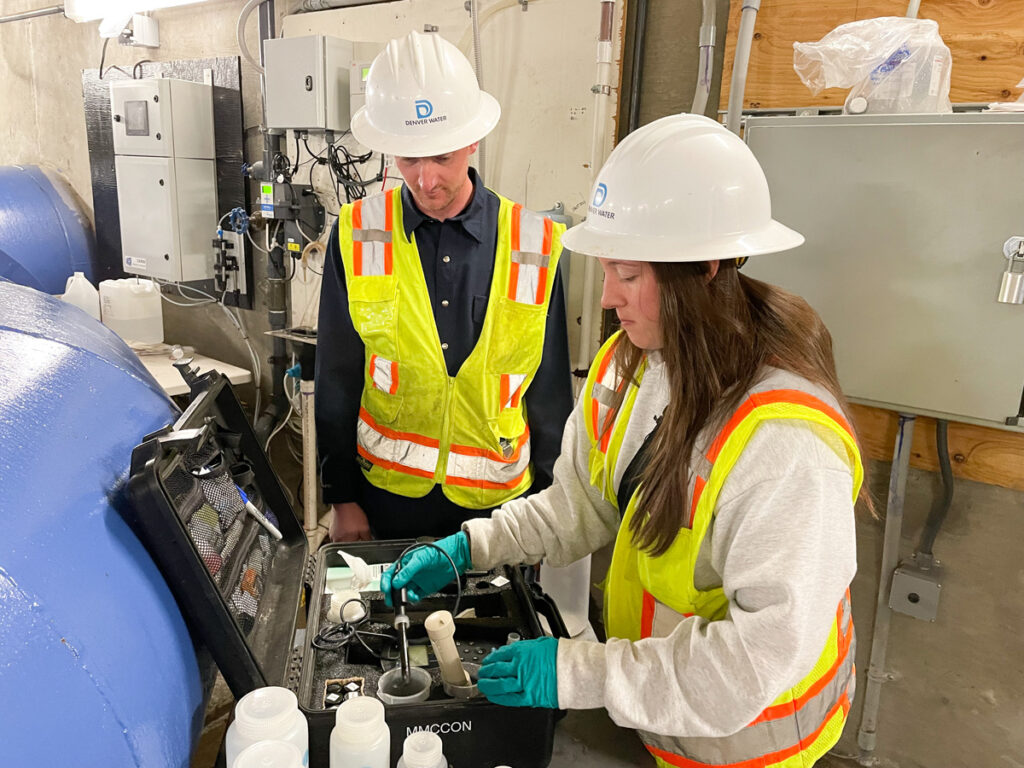
Water quality teams travel to eight counties and collect samples from 77 watershed locations. Water samples from the collection area are tested by our lab to understand in and around our water supply. Samples that veer from typical readings could indicate unexpected pollution, echoes of old mining activity or, increasingly, the impacts of forest fires. Understanding these impacts helps prepare operators for potential impacts to reservoirs and so we can adjust our treatment process, if needed.
DENVER WATER LAB HOURS
Monday-Friday: 8:30 a.m.-5 p.m.
Saturday: Closed
Sunday: Closed
Above are the hours for the Denver Water water quality lab. CSU Spur is open 9 a.m.-5 p.m. Monday-Friday and the 2nd Saturday of every month from 10 a.m.-3 p.m.

A new environment
On the Spur campus, Denver Water is in the heart of a new research environment, in a spot where we can work closely with academics and innovators studying a wide spectrum of current and emerging water quality issues and solutions as we continue to deliver safe, reliable, great-tasting water to the Denver metro area today and in the future. Being part of the Spur campus also puts Denver Water in a space where we can better develop solutions to emerging water challenges for our customers and the state, while expanding on our robust youth education program to develop future water leaders.
This new location shifts the lab from an obscure setting, tucked away behind security gates near the Marston Treatment Plant in southwest Denver, to the CSU Spur complex, situated at a well-trafficked location at an innovative new campus in an historic area of Denver.
The new lab provides improved space for Denver Water’s continual water quality analysis to monitor water from the mountains to its treatment plants, through its distribution system and what comes out of the tap. The new location provides capacity for nearly three times as many tests, as well as more room for research and collaboration.

Hours
Monday-Friday: 9 a.m.-5 p.m.
2nd Saturday of every month: 10 a.m.-2 p.m. (closed all other Saturdays)
Closed Sundays
Location
4777 National Western Dr.,
Denver, CO 80216
© 2024 Colorado State University System.
All Rights Reserved.
Privacy Policy | Equal Opportunity Statement
JOCELYN HITTLE
Associate Vice Chancellor for CSU Spur & Special Projects, CSU System
Jocelyn Hittle is primarily focused on helping to create the CSU System’s new Spur campus at the National Western Center, and on supporting campus sustainability goals across CSU’s campuses. She sits on the Denver Mayor’s Sustainability Advisory Council, on the Advisory Committee for the Coors Western Art Show, and is a technical advisor for the AASHE STARS program.
Prior to joining CSU, Jocelyn was the Associate Director of PlaceMatters, a national urban planning think tank, and worked for the Orton Family Foundation. She has a degree in Ecology and Evolutionary Biology from Princeton, and a Masters in Environmental Management from the Yale School of Forestry and Environmental Studies.
Jocelyn grew up in Colorado and spends her free time in the mountains or exploring Denver.

TONY FRANK
Chancellor, CSU System
Dr. Tony Frank is the Chancellor of the CSU System. He previously served for 11 years as the 14th president of CSU in Fort Collins. Dr. Frank earned his undergraduate degree in biology from Wartburg College, followed by a Doctor of Veterinary Medicine degree from the University of Illinois, and a Ph.D. and residencies in pathology and toxicology at Purdue. Prior to his appointment as CSU’s president in 2008, he served as the University’s provost and executive vice president, vice president for research, chairman of the Pathology Department, and Associate Dean for Research in the College of Veterinary Medicine and Biomedical Sciences. He was appointed to a dual role as Chancellor in 2015 and became full-time System chancellor in July 2019.
Dr. Frank serves on a number of state and national boards, has authored and co-authored numerous scientific publications, and has been honored with state and national awards for his leadership in higher education.
Dr. Frank and his wife, Dr. Patti Helper, have three daughters.
We’ll see you Saturday!
2nd Saturday at CSU Spur is 10 a.m.-2 p.m. this Saturday (April 13)! The theme is the Big Bloom.
Hope to see you there!